

A new Chemical Brothers album turned up in my Spotify Release Radar today. Twelve tracks, an hour and eight minutes, called Go: Apex And Beyond. None of it is new. It’s a greatest-hits compilation, and they named it after a Netflix movie. That’s not the interesting bit.
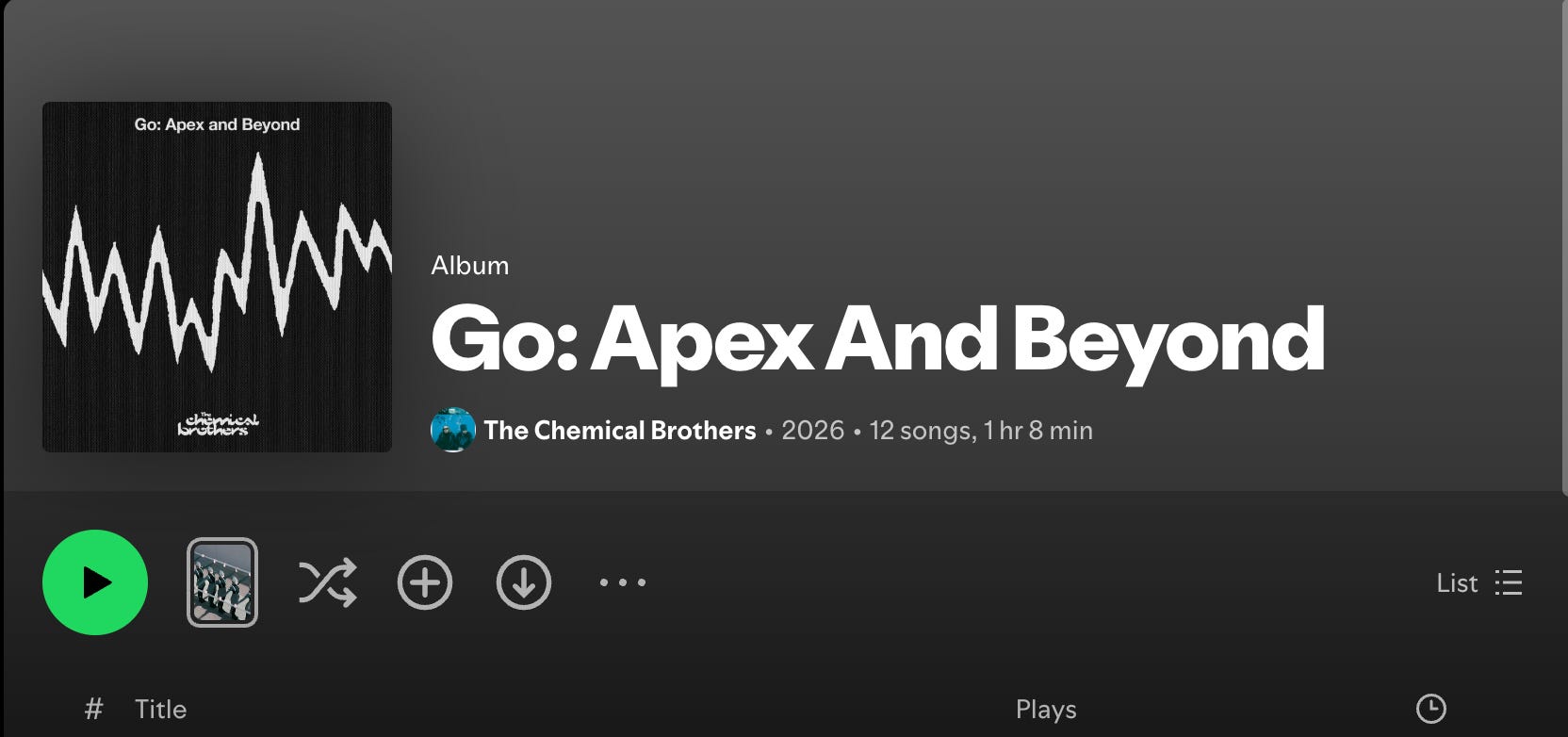
The interesting bit is what happened in the five weeks before that screenshot.
First, a short history. “Go” came out in 2015, peaked at number 46, and went back to sleep for a decade. Then Apex landed on Netflix on April 24, a survival thriller where Taron Egerton hunts Charlize Theron through the Australian bush. In one scene he puts “Go” on the radio, tells her she has until the song ends to run, and does a deranged little dance while he waits. The dance was improvised. It became a meme. Stressed parents started filming themselves telling their kids they had until the end of the song to get as far away as possible.
The song jumped 429% on Spotify in a week. Number one on Shazam worldwide. Back in the UK top ten for the first time in over twenty years. And then, right on cue, the album.
None of which is new, exactly. Old song meets screen, screen goes viral, song comes back. Kate Bush did it in 2022 with Stranger Things. “Stuck in the Middle With You” did it after Reservoir Dogs. If that were all this was, I wouldn’t bother writing it down.
But Kate Bush needed you to watch the show. “Running Up That Hill” came back because Stranger Things was good and everybody watched it. The work was the delivery mechanism. You had to press play on the long thing to get the short thing.

“Go” didn’t need the movie. What actually spread was thirty seconds of a man dancing, clipped out, re-skinned a thousand ways, used by people who’ll never watch Apex and half of whom think it’s from the video game Apex Legends. You can see the difference in the numbers. Apex viewership went up in its second week on Netflix, 38 million to 40 million, which films basically never do. The meme fed the film and fed the song to everyone who skipped the film. Discovery came unbundled from the thing being discovered.
And it didn’t start with a label. It started with Taron Egerton, a lifelong Chemical Brothers fan, who hand-wrote a letter begging them to clear a ten-year-old track. “I need The Chemical Brothers’ help.” Then he made the dance up on set. The crowd did the rest of the marketing for nothing. By the time anyone at a label had a decision to make, the only one left was how fast they could ship something to sell. So they swept the back catalogue into a compilation, put “Go” on top, and named it after the movie that did the work.
I kept thinking about an old episode of The Rest Is Entertainment while I watched this play out. Marina Hyde and Richard Osman were talking about the swarm of true-crime documentaries around the Australian mushroom-poisoning trial, and how fast they arrive now. “News has become IP,” one of them says, “and it’s become IP really quickly.” They point out that Fyre Festival happened in 2017 and the documentaries didn’t land until 2019, and that a two-year gap now looks “ancient.” The mushroom docs were being built during the trial, framed for either verdict, ready to ship the moment it ended.
A greatest-hits record used to mark the end of something: a career mostly behind you, a band taking its bow. Now it shows up in the middle of the spike, while the moment’s still hot, to catch the attention before it scrolls away. The documentary used to be what you made once a story was over and you’d had time to understand it. As one of them puts it on the show, “a lot of our culture is set ten minutes into the past now.” We’re not looking back. We’re rehashing the thing that happened ten minutes ago, because the tools let us and the attention is right there.
Maybe that’s fine. Q-Tip gets a royalty cheque. A genuinely great track reaches people who were toddlers when it came out. Nobody’s harmed by a Chemical Brothers compilation, and I’d be a snob to pretend the old gatekept world was better at finding good music. It mostly wasn’t.
But something does get lost when the cash-in arrives this fast. The gap used to do work. The years between the event and the retrospective were when you figured out what the thing meant. Now, there’s no gap. Supply shows up at the speed of the attention, while everyone’s still inside the moment, and nothing gets the distance it needs to become more than content. A mushroom documentary that airs during the trial can’t tell you what the trial meant, because the trial isn’t over.
So nothing gets to be over. It just loops, sold back to us while it’s still happening.